GD Bauer
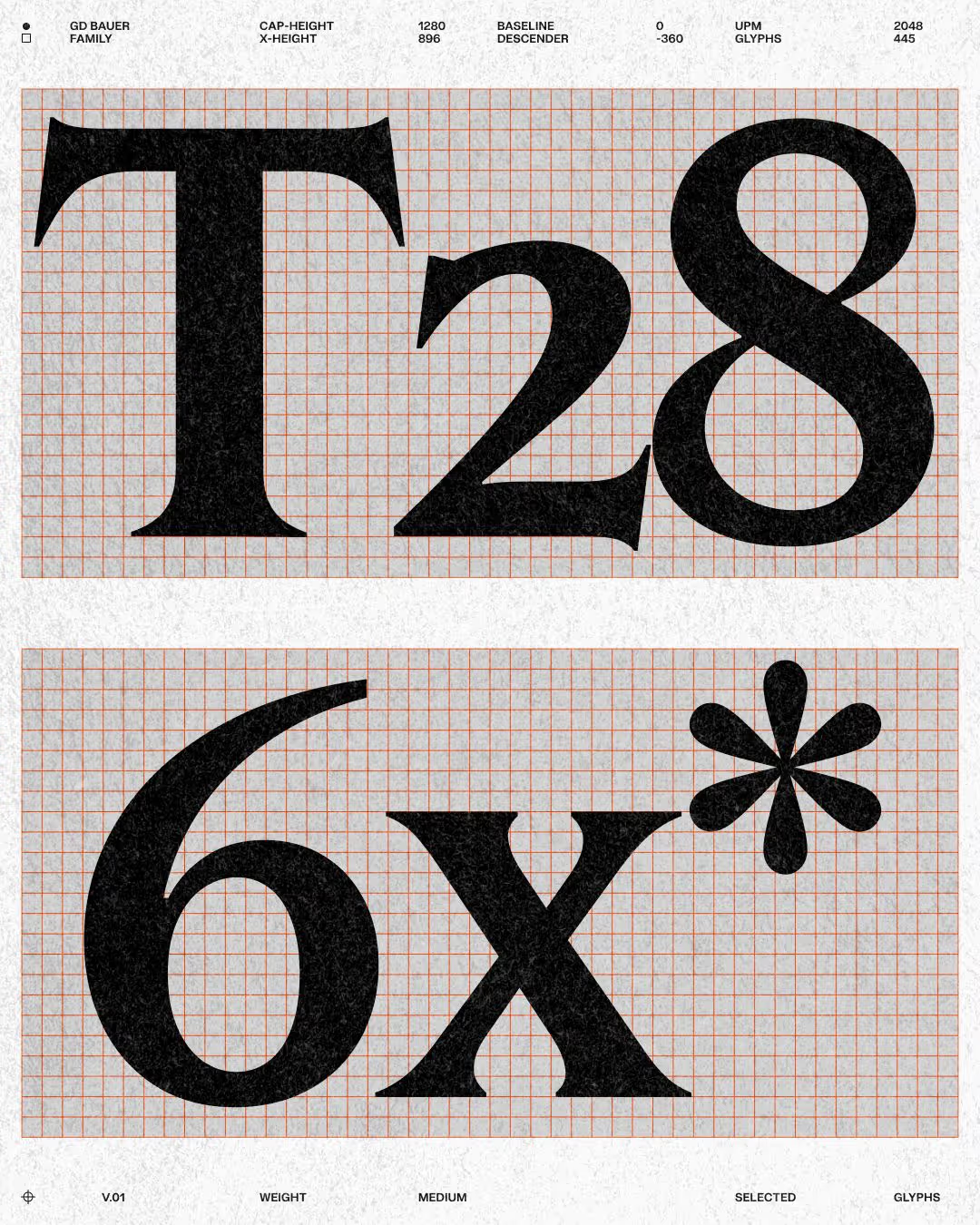
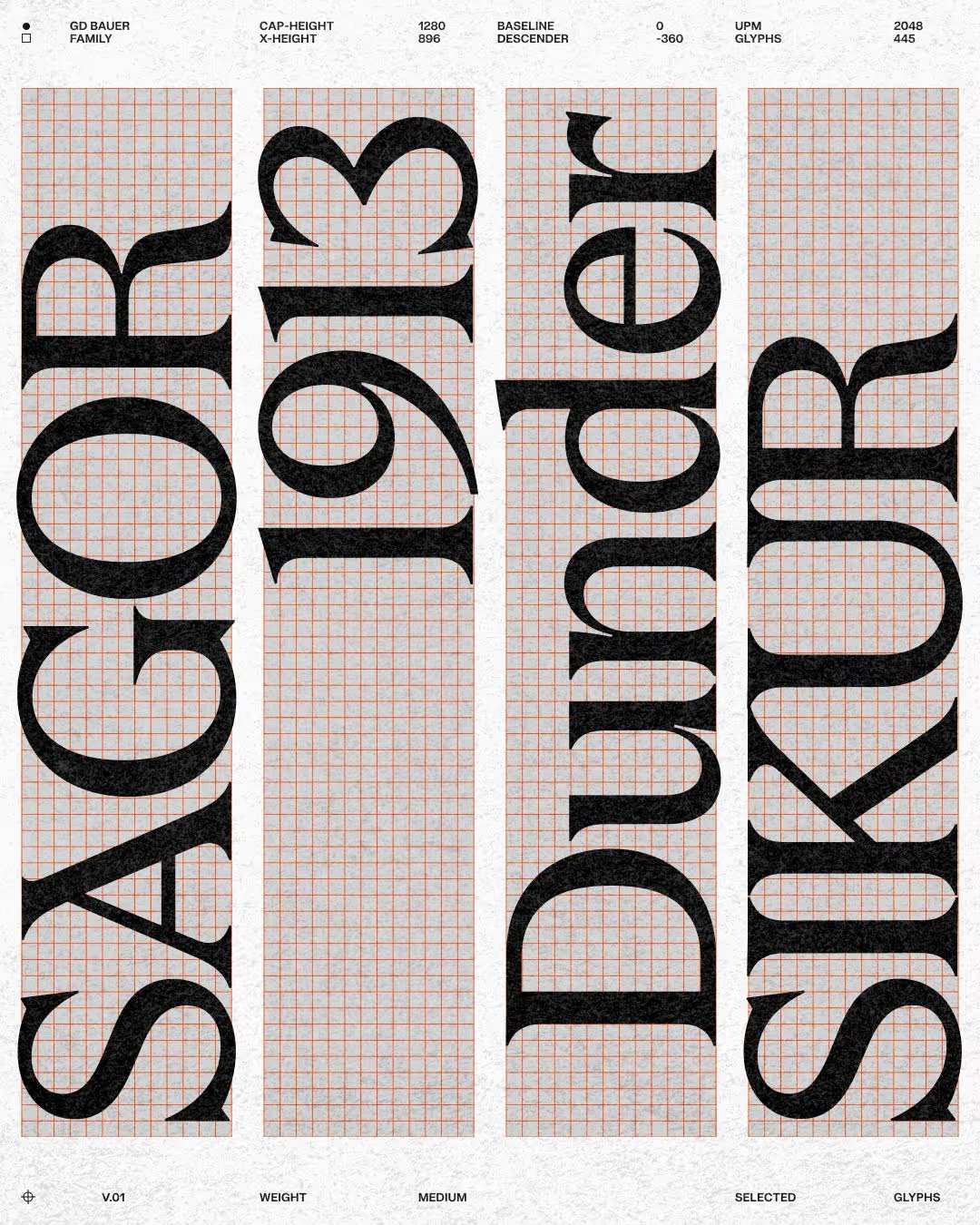
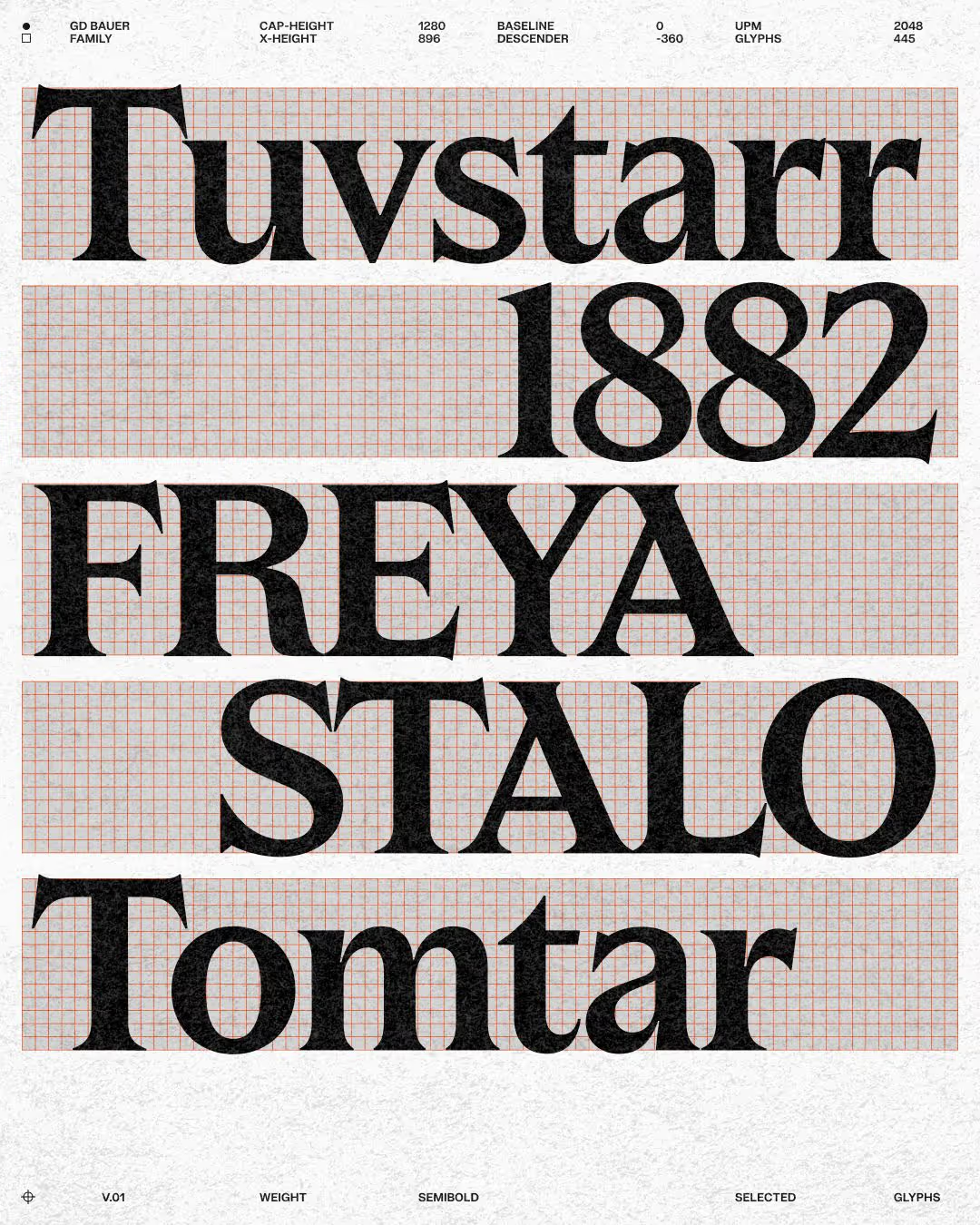
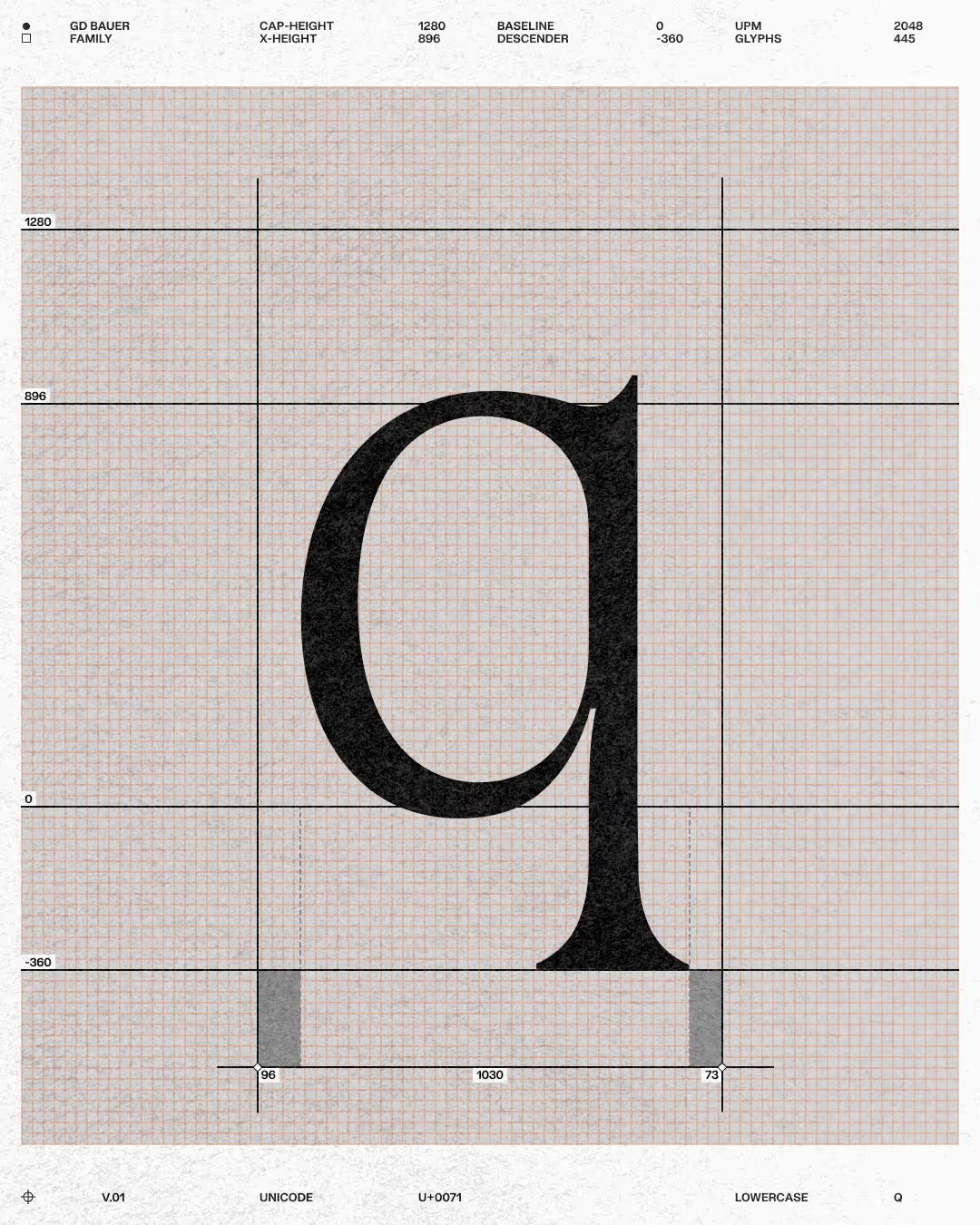
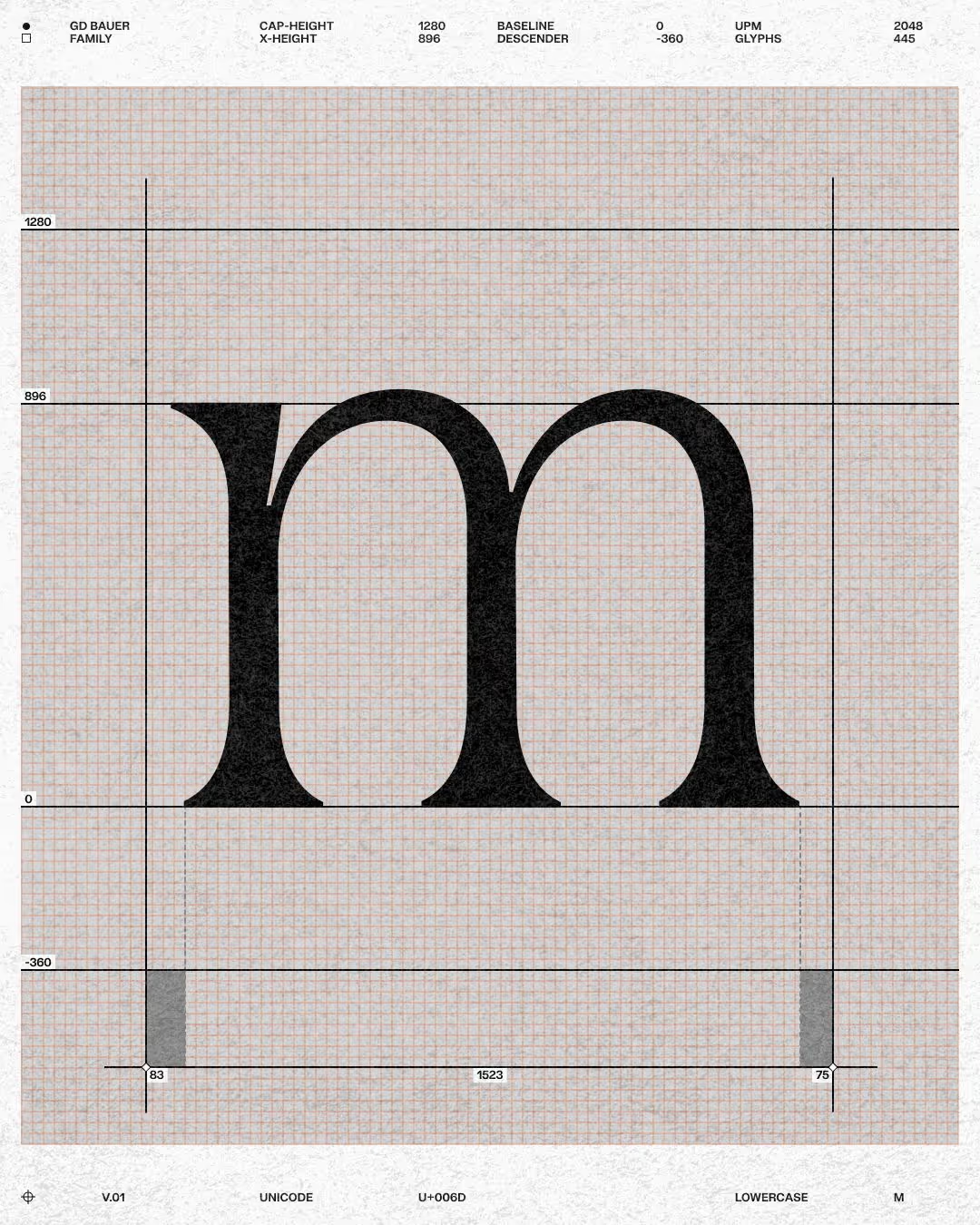
GD Bauer is a display serif rooted in a 19th century European typeface tradition, with pointed serifs and harmonized proportions. The stroke contrast is even, which keeps it feeling contemporary despite the historical references. Ink traps add depth at display sizes. Sharp where it counts, rounded where it breathes. Assured and elegant, but with real character.
Few typefaces with this much personality work at body size. GD Bauer does, with a text version built to carry its character all the way down.
Named after John Bauer (1882–1918), the Swedish illustrator whose forests, trolls and silent princesses still carry the charge of something ancient and half-seen. A fitting name for a typeface built on the same conviction: that craft and feeling are never opposites.
- Year
- 2026
- Designer(s)
- Marcus Gärde · Anders Wikström · Paola Alonso Chapel
- Style
- Serif
- Weights
- Display Light · Display Regular · Display Medium · Display Semibold · Display Bold · Display Black · Text Regular · Text Medium · Text Semibold · Text Bold
- Features
- Open Type Alternates · Proportional Numbers · Tabular Numbers
- Languages
- 200+
- UPM
- 2048
GD Bauer – Craft & Feeling
GD Bauer is a display serif rooted in a 19th century European typeface tradition, with pointed serifs and harmonized proportions. The stroke contrast is even, which keeps it feeling contemporary despite the historical references. Ink traps add depth at display sizes. Sharp where it counts, rounded where it breathes. Assured and elegant, but with real character.
Few typefaces with this much personality work at body size. GD Bauer does, with a text version built to carry its character all the way down.
Named after John Bauer (1882–1918), the Swedish illustrator whose forests, trolls and silent princesses still carry the charge of something ancient and half-seen. A fitting name for a typeface built on the same conviction: that craft and feeling are never opposites.
- Year
- 2026
- Designer(s)
- Marcus GärdeAnders WikströmPaola Alonso Chapel
- Style
- Serif
- Weights
- Display LightDisplay RegularDisplay MediumDisplay SemiboldDisplay BoldDisplay BlackText RegularText MediumText SemiboldText Bold
- Features
- Open Type AlternatesProportional NumbersTabular Numbers
- Languages
- 200+
- UPM
- 2048
- GD Bauer
- Weight
- Light
- wght
- 300
- Range
- 300–800
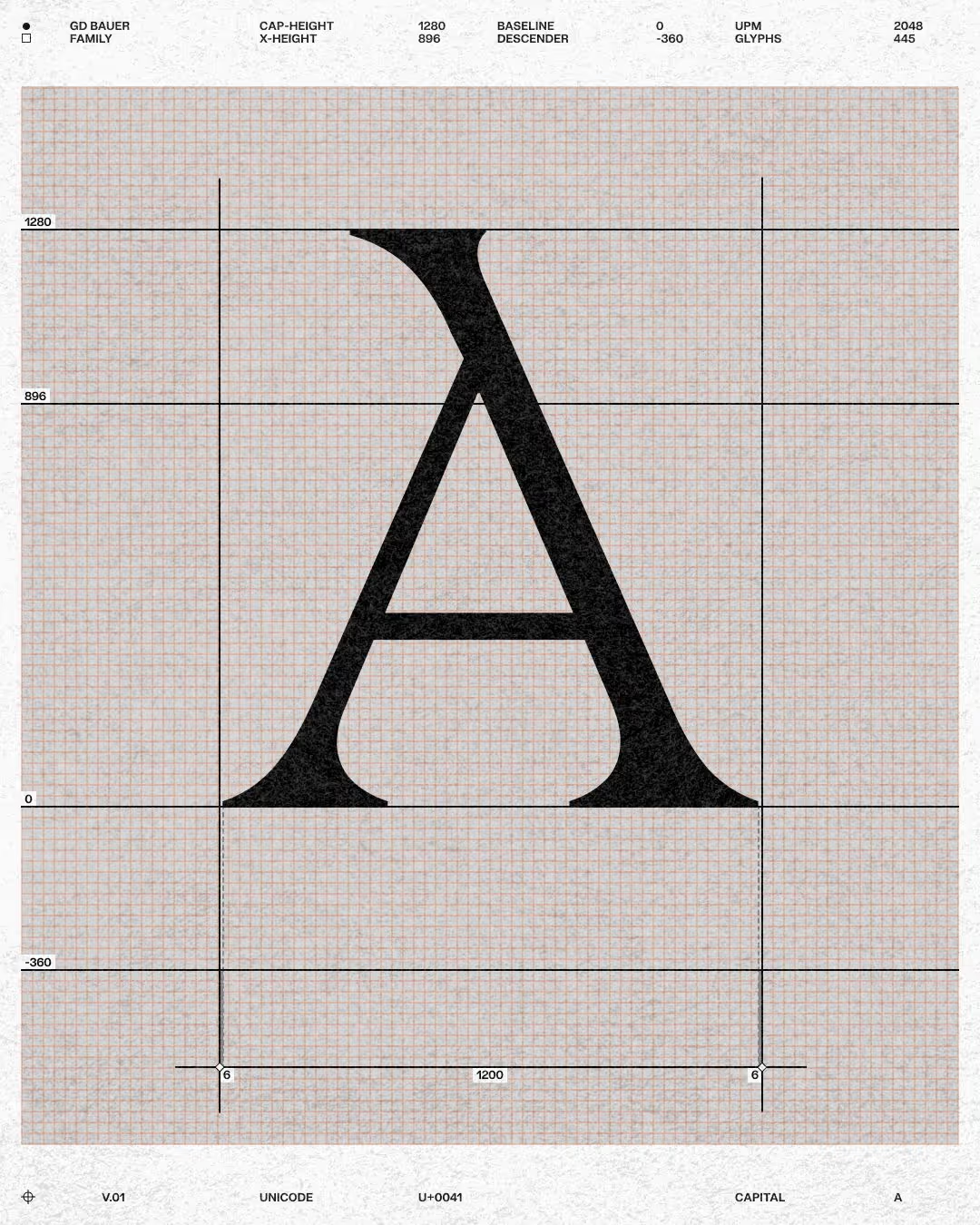
- Unicode name
- Latin Capital Letter A
- Unicode decimal
- 65
- Unicode hex
- 0041
- Block
- Basic Latin
Latin script
Acheron, Achinese, Acholi, Afar, Afrikaans, Alekano, Amahuaca, Amarakaeri, Amis, Anaang, Dongolawi (Andaandi), Anuta, Aragonese, Arbëreshë Albanian, Asháninka, Ashéninka (Perené, Pichis), Balinese, Banjar, Bari, Basque, Batak (Dairi, Karo, Mandailing, Simalungun, Toba), Bemba (Zambia), Bena (Tanzania), Bikol, Bislama, Oromo (Borana, Arsi, Guji, Eastern, West Central), Breton, Buginese, Candoshi-Shapra, Caquinte, Caribbean Hindustani, Cashibo-Cacataibo, Cebuano, Aymara (Central, Southern), Chachi, Chamorro, Chavacano, Chiga, Chiltepec Chinantec, Chokwe, Chuukese, Cimbrian, Cofán, Cook Islands Māori, Cornish, Corsican, Creek, Crimean Tatar, Croatian, Czech, Dehu, Dutch, Arrernte (Eastern), English, Faroese, Fijian, Filipino, Finnish, French, Friulian, Gagauz, Galician, Ganda, Garifuna, German, Albanian (Gheg, Tosk), Gilbertese, Gooniyandi, Gourmanchéma, Guadeloupean Creole French, Gusii, Haitian Creole, Hani, Hiligaynon, Hopi, Huastec, Hungarian, Iloko, Indonesian, Irish, Istro-Romanian, Italian, Ixcatlán Mazatec, Jamaican Creole English, Javanese, Jola-Fonyi, K’iche’, Kabuverdianu (Cape Verdean Creole), Kalaallisut (Greenlandic), Kalenjin, Kaonde, Karelian, Kashubian, Q’eqchi’ (Kekchí), Kenzi-Mattokki, Khasi, Kimbundu, Kinyarwanda, Kituba (DRC), Kongo, Konzo, Kven Finnish, Ladin, Ladino (Judeo-Spanish), Latgalian, Lithuanian, Lombard, Low German, Sorbian (Lower, Upper), Luba-Lulua, Luo (Kenya & Tanzania), Luxembourgish, Aromanian (Macedo-Romanian), Makonde, Malagasy, Malay (Standard, Malaysian), Maltese, Mandinka, Mankanya, Manx, Comorian (Maore, Ngazidja), Māori, Mapudungun, Marshallese, Matsés, Mauritian Creole, Meriam Mir, Meru, Mezquital Otomi, Minangkabau, Mohawk, Montenegrin, Murrinh-Patha, Mwani, Miskito, Naga Pidgin, Ndonga, Neapolitan, Niuean, Nobiin, Nomatsiguenga, Ndebele (North, South), Uzbek (Northern), Norwegian, Nyanja (Chichewa), Nyankole, Occitan, Ojitlán Chinantec, Orma, Oroqen, Palauan, Pampanga, Papantla Totonac, Papiamento, Pedi (Northern Sotho), Picard, Piedmontese, Pijin, Pintupi-Luritja, Pipil, Pohnpeian, Polish, Portuguese, Potawatomi, Purepecha, Romanian, Romansh, Rotokas, Rundi (Kirundi), Samoan, Sango, Sangu (Tanzania), Saramaccan, Sardinian, Scots, Scottish Gaelic, Secoya, Sena, Seri, Seselwa Creole French (Seychellois), Shawnee, Shipibo-Conibo, Shona, Sicilian, Silesian, Slovak, Slovenian, Soga, Somali, Soninke, Miao (Northern & Southern Qiandong), Sotho (Southern), Spanish, Sranan Tongo, Estonian, Latvian, Sundanese, Swahili, Swedish, Swiss German, Tagalog, Tahitian, Tedim Chin, Tetum (Dili), Tok Pisin, Tokelau, Tongan (Islands, Zambia), Tumbuka, Turkish, Turkmen, Tzeltal, Tzotzil, Uab Meto, Crioulo (Upper Guinea), Venetian, Veps, Võro, Walloon, Waray (Philippines), Warlpiri, Wayuu, Welsh, Abnaki (Western), Frisian (Western), Wiradjuri, Wolof, Xhosa, Yanesha’, Yao, Yucatec Maya, Zapotec, Zulu, Záparo.