GD Unio
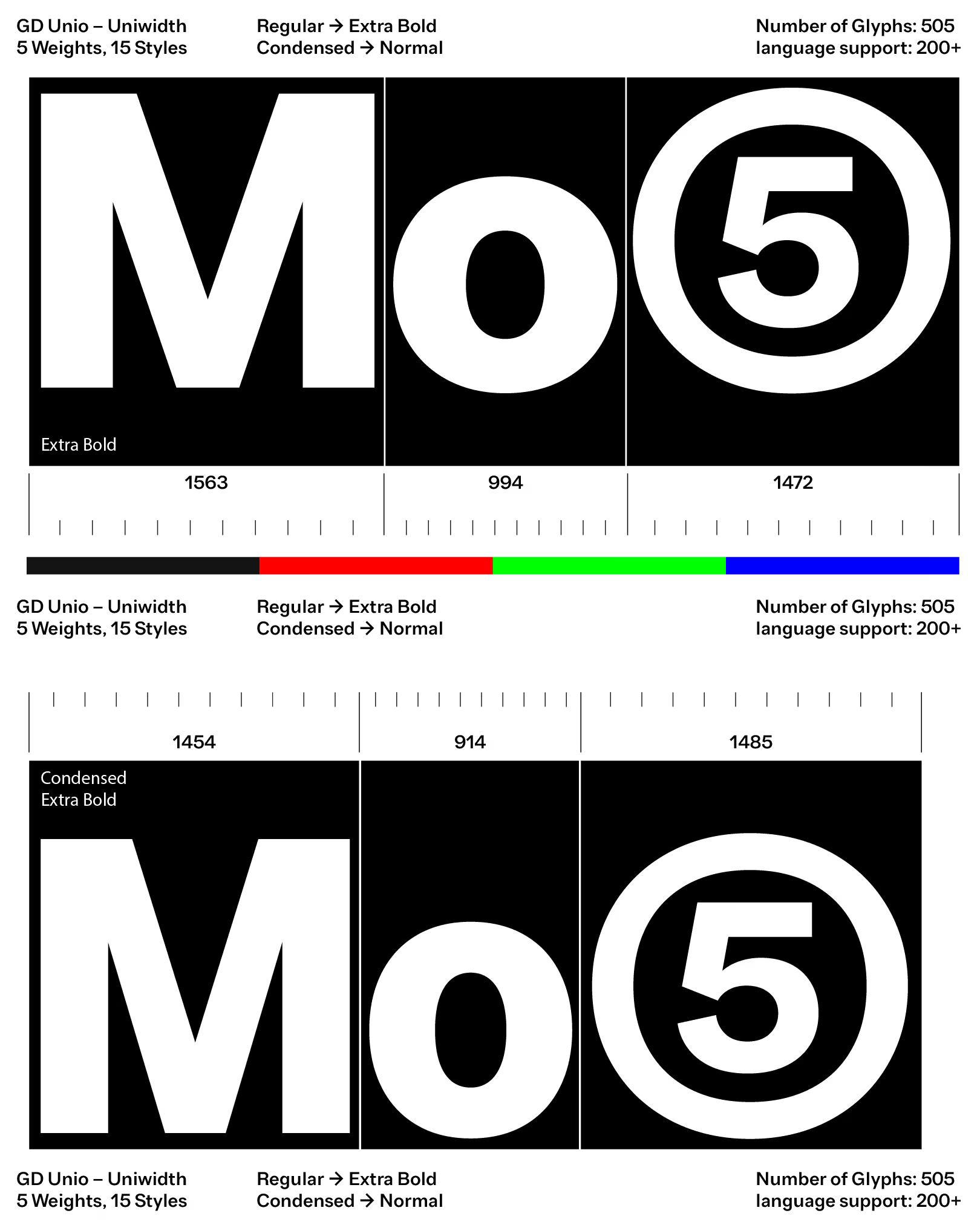
GD Unio is a contemporary typeface built on the principle of uniwidth, where each character retains the same horizontal space across all weights and styles. Switch from Regular to Bold, or all the way to Extra Bold, and the text stays exactly where it is. No reflow, no changing line lengths, no layout surprises. This makes GD Unio exceptionally well-suited for digital interfaces. Buttons hold their size on hover. Hyperlinks don't nudge neighbouring elements when they go active. Labels stay locked in place through every state change. In dynamic UIs where multiple weights coexist or toggle in real time, GD Unio simply holds steady while everything else moves around it. The uniwidth approach is very handy when it comes to buttons, hyperlinks or other UI-elements.
- Year
- 2026
- Designer(s)
- Marcus Gärde · Anders Wikström
- Style
- Uniwidth
- Weights
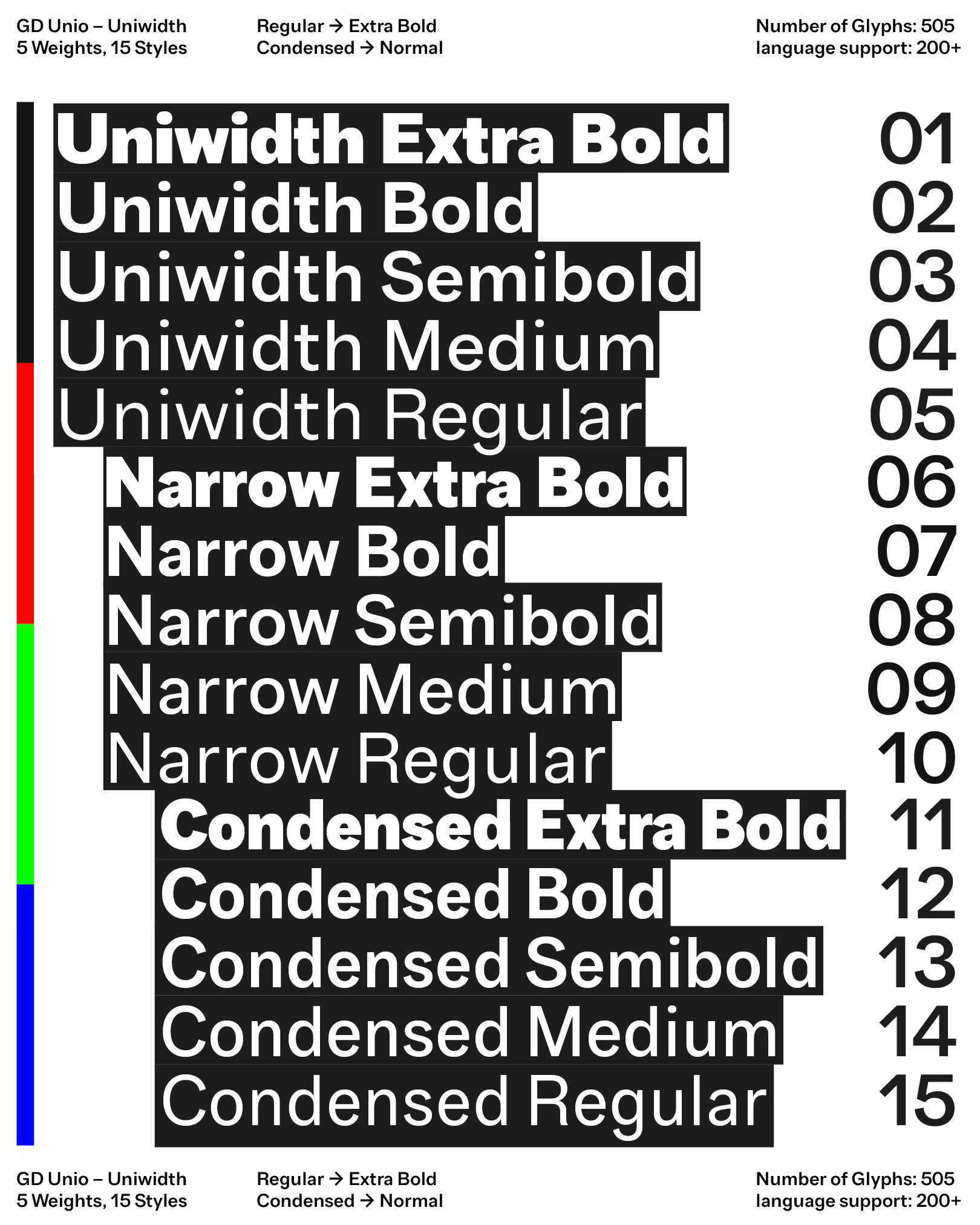
- Regular · Medium · Semibold · Bold · Extra Bold · Condensed Regular · Condensed Medium · Condensed Semibold · Condensed Bold · Condensed Extra Bold · Narrow Regular · Narrow Medium · Narrow Semibold · Narrow Bold · Narrow Extra Bold
- Features
- Open Type Alternates · Proportional Numbers · Tabular Numbers
- Languages
- 200+
- UPM
- 2816
GD Unio – The Contemporary UI-font
GD Unio is a contemporary typeface built on the principle of uniwidth, where each character retains the same horizontal space across all weights and styles. Switch from Regular to Bold, or all the way to Extra Bold, and the text stays exactly where it is. No reflow, no changing line lengths, no layout surprises. This makes GD Unio exceptionally well-suited for digital interfaces. Buttons hold their size on hover. Hyperlinks don't nudge neighbouring elements when they go active. Labels stay locked in place through every state change. In dynamic UIs where multiple weights coexist or toggle in real time, GD Unio simply holds steady while everything else moves around it. The uniwidth approach is very handy when it comes to buttons, hyperlinks or other UI-elements.
- Year
- 2026
- Designer(s)
- Marcus GärdeAnders Wikström
- Style
- Uniwidth
- Weights
- RegularMediumSemiboldBoldExtra BoldCondensed RegularCondensed MediumCondensed SemiboldCondensed BoldCondensed Extra BoldNarrow RegularNarrow MediumNarrow SemiboldNarrow BoldNarrow Extra Bold
- Features
- Open Type AlternatesProportional NumbersTabular Numbers
- Languages
- 200+
- UPM
- 2816
- GD Unio
- Weight
- Light
- wght
- 400
- Range
- 400–900
- Unicode name
- Latin Capital Letter A
- Unicode decimal
- 65
- Unicode hex
- 0041
- Block
- Basic Latin
Latin script
Acheron, Achinese, Acholi, Afar, Afrikaans, Alekano, Amahuaca, Amarakaeri, Amis, Anaang, Dongolawi (Andaandi), Anuta, Aragonese, Arbëreshë Albanian, Asháninka, Ashéninka (Perené, Pichis), Balinese, Banjar, Bari, Basque, Batak (Dairi, Karo, Mandailing, Simalungun, Toba), Bemba (Zambia), Bena (Tanzania), Bikol, Bislama, Oromo (Borana, Arsi, Guji, Eastern, West Central), Breton, Buginese, Candoshi-Shapra, Caquinte, Caribbean Hindustani, Cashibo-Cacataibo, Cebuano, Aymara (Central, Southern), Chachi, Chamorro, Chavacano, Chiga, Chiltepec Chinantec, Chokwe, Chuukese, Cimbrian, Cofán, Cook Islands Māori, Cornish, Corsican, Creek, Crimean Tatar, Croatian, Czech, Dehu, Dutch, Arrernte (Eastern), English, Faroese, Fijian, Filipino, Finnish, French, Friulian, Gagauz, Galician, Ganda, Garifuna, German, Albanian (Gheg, Tosk), Gilbertese, Gooniyandi, Gourmanchéma, Guadeloupean Creole French, Gusii, Haitian Creole, Hani, Hiligaynon, Hopi, Huastec, Hungarian, Iloko, Indonesian, Irish, Istro-Romanian, Italian, Ixcatlán Mazatec, Jamaican Creole English, Javanese, Jola-Fonyi, K’iche’, Kabuverdianu (Cape Verdean Creole), Kalaallisut (Greenlandic), Kalenjin, Kaonde, Karelian, Kashubian, Q’eqchi’ (Kekchí), Kenzi-Mattokki, Khasi, Kimbundu, Kinyarwanda, Kituba (DRC), Kongo, Konzo, Kven Finnish, Ladin, Ladino (Judeo-Spanish), Latgalian, Lithuanian, Lombard, Low German, Sorbian (Lower, Upper), Luba-Lulua, Luo (Kenya & Tanzania), Luxembourgish, Aromanian (Macedo-Romanian), Makonde, Malagasy, Malay (Standard, Malaysian), Maltese, Mandinka, Mankanya, Manx, Comorian (Maore, Ngazidja), Māori, Mapudungun, Marshallese, Matsés, Mauritian Creole, Meriam Mir, Meru, Mezquital Otomi, Minangkabau, Mohawk, Montenegrin, Murrinh-Patha, Mwani, Miskito, Naga Pidgin, Ndonga, Neapolitan, Niuean, Nobiin, Nomatsiguenga, Ndebele (North, South), Uzbek (Northern), Norwegian, Nyanja (Chichewa), Nyankole, Occitan, Ojitlán Chinantec, Orma, Oroqen, Palauan, Pampanga, Papantla Totonac, Papiamento, Pedi (Northern Sotho), Picard, Piedmontese, Pijin, Pintupi-Luritja, Pipil, Pohnpeian, Polish, Portuguese, Potawatomi, Purepecha, Romanian, Romansh, Rotokas, Rundi (Kirundi), Samoan, Sango, Sangu (Tanzania), Saramaccan, Sardinian, Scots, Scottish Gaelic, Secoya, Sena, Seri, Seselwa Creole French (Seychellois), Shawnee, Shipibo-Conibo, Shona, Sicilian, Silesian, Slovak, Slovenian, Soga, Somali, Soninke, Miao (Northern & Southern Qiandong), Sotho (Southern), Spanish, Sranan Tongo, Estonian, Latvian, Sundanese, Swahili, Swedish, Swiss German, Tagalog, Tahitian, Tedim Chin, Tetum (Dili), Tok Pisin, Tokelau, Tongan (Islands, Zambia), Tumbuka, Turkish, Turkmen, Tzeltal, Tzotzil, Uab Meto, Crioulo (Upper Guinea), Venetian, Veps, Võro, Walloon, Waray (Philippines), Warlpiri, Wayuu, Welsh, Abnaki (Western), Frisian (Western), Wiradjuri, Wolof, Xhosa, Yanesha’, Yao, Yucatec Maya, Zapotec, Zulu, Záparo.